Figures for Mobile: $1,500–$6,000 covers ordinary remediation, $2,500–$9,000 the work beneath a house, $1,500–$5,000 an attic, $1,000–$4,000 a duct system, and $6,000–$15,000 a whole-house job. Nothing is charged to come out.
What sits inside each band, why bids here come in two parts, and how to weigh two documents that are not describing the same work.
Every job, with its number
| Work | Range | What is included |
|---|---|---|
| One wall, one room | $1,500–$3,000 | Sealed work area, HEPA under negative pressure, colonized material out, dried to a number |
| Ordinary remediation | $1,500–$6,000 | Several areas at once, framing treated where it stands, verification readings at the end |
| Underneath the house | $2,500–$9,000 | Joists, subfloor, and sill on a crawl or pier foundation, with the moisture source handled |
| Attic work | $1,500–$5,000 | Sheathing treated, failed duct wrap made good, gaps in the ceiling plane closed |
| Duct systems | $1,000–$4,000 | Coil, pan, and blower attended to, returns tightened, flex runs swapped where cleaning will not hold |
| Drying after a storm | $1,000–$8,000 | Water out, drywall cut to a metered line, dehumidification, and a record your adjuster can use |
| Whole-house or structural | $6,000–$15,000 | Several assemblies involved, heavy demolition, and rebuilding handled in stages |
| Testing by a third party | $300–$800 | Independent sampling, for the arguments and the mysteries rather than the obvious cases |
| Mechanical odds and ends | $150–$1,500 | A length of duct wrap, a fan run to the outside, one lap of sealant above a window |
Why a Gulf Coast quote has two halves
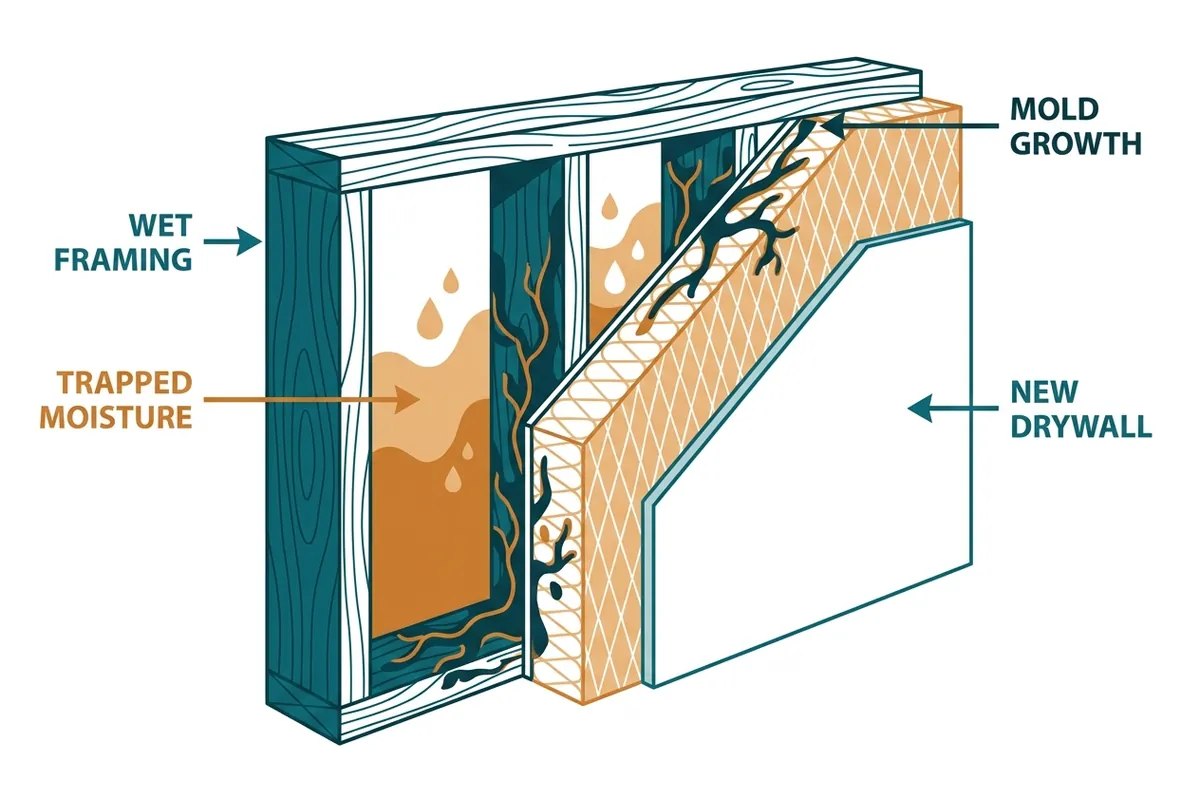
Remediation removes what grew. Closing the entry path stops it growing again, and on this coast the entry path is frequently an exterior building detail — a window head, a step flashing, a pipe boot, a cladding lap. That work belongs to a roofer, a siding contractor, or a glazier as often as it belongs to us.
Which produces the most common apples-to-oranges comparison in this market. One bid prices remediation only. Another prices remediation plus the repair. The second looks expensive and is frequently the cheaper of the two, because the first one is going to happen again. Ask every bidder, explicitly, whether the entry-path repair is in their number or out of it.
Six things push the total around
- How much of it is porous. Sheetrock and batt insulation leave the building; structural lumber gets treated where it sits
- Area. Bigger footprint means more barrier, more hours, more debris to haul
- Getting to it. Eighteen inches of crawl clearance, or an attic in July, is slower work than a bedroom at eye level
- Whose job the repair is. Roofer, glazier, siding contractor, or us — and whether it is inside the figure
- How fast you moved. On a wet house this outweighs everything else on the list, and it is not our decision
- Putting it back. Finish carpentry and paint come after, usually from somebody else
Making two bids answerable to each other
Look for the same half-dozen features in both documents: a standard cited by name, barrier and negative pressure written down rather than assumed, a clear split between demolition and cleaning, drying expressed as a moisture value, an explanation of how the water arrived, and prices broken out by line.
Both documents carrying all six? Then price is a fair basis for choosing. One of them offering a lump sum and a species name is not a competing bid, it is an unrelated object — and it is usually the one you will be calling back in October. The black mold page goes further into the language problem, which peaks in the fortnight after a system comes ashore.
Do it in this order or buy it twice
Shut the water out, take the growth out, put the finishes back. Follow that and no assembly gets demolished more than once. Invert it — finish the room in June, discover the flashing in September — and you will purchase the identical sheet of drywall in consecutive years.
Tight on money? Ask for the stages split with a firm figure on each. Stopping the intrusion now and living with unfinished drywall until spring is a legitimate plan, not a half-measure, and we will write it that way.
Price, answered plainly
What is the average mold removal cost in Mobile?
An average across these would fit no actual house. Take them separately: one wall, $1,500-$3,000. A normal remediation, $1,500-$6,000. Underneath, $2,500-$9,000. Attic, $1,500-$5,000. Ducts, $1,000-$4,000. Post-storm drying, $1,000-$8,000. Whole-house and structural, $6,000-$15,000.
Why do two Mobile quotes differ by thousands?
Usually scope, and specifically whether the entry-path repair is inside the number or outside it. One company prices remediation only; another prices remediation plus the flashing or cladding work that stops it recurring. Those are not competing prices, they are different jobs.
Why is your quote sometimes lower than a competitor's?
Because a real share of what we find has a small mechanical cause - a length of failed duct insulation, a system that never runs long enough to dehumidify, a window head detail. Where that is the answer, a full containment setup is the wrong thing done well, and we would rather say so.
Does insurance cover it?
When the water arrived suddenly through a covered loss - including wind-driven rain through a storm-created opening - frequently yes, subject to a mold sublimit and, after a named storm, a percentage deductible. Humidity and condensation growth is generally excluded.
Can the work be phased?
The work can be phased, in a specific order: close the entry path, remediate, then rebuild. Nothing gets opened twice that way. Rebuilding before the entry path is closed means paying for the same drywall after the next tropical band, which is not a hypothetical here.
Do you charge for the inspection?
Not a dollar. Readings, the weather questions, the walk around the outside, going underneath, the attic, the photographs, and the priced document at the end all come at no charge - including the calls that finish with us pointing at a torn foot of duct wrap and driving off.
Get a free Mobile mold inspection
Describe what you have found — a stain that appears only after a hard blow, a room that smells musty every August, dark growth behind furniture on an outside wall, a ceiling mark that showed up after a storm. Two details help most: which wall, and whether it tracks the weather. Expect a reply the same working day.